distributed/fabric-x.yaml
fabric-x.yaml is a multi-machine SSH inventory for performance-oriented Fabric-X evaluation.
This inventory is not ready to run as-is. Replace the host_machine_* placeholders with real machines and confirm SSH access before using it.
Network Diagram
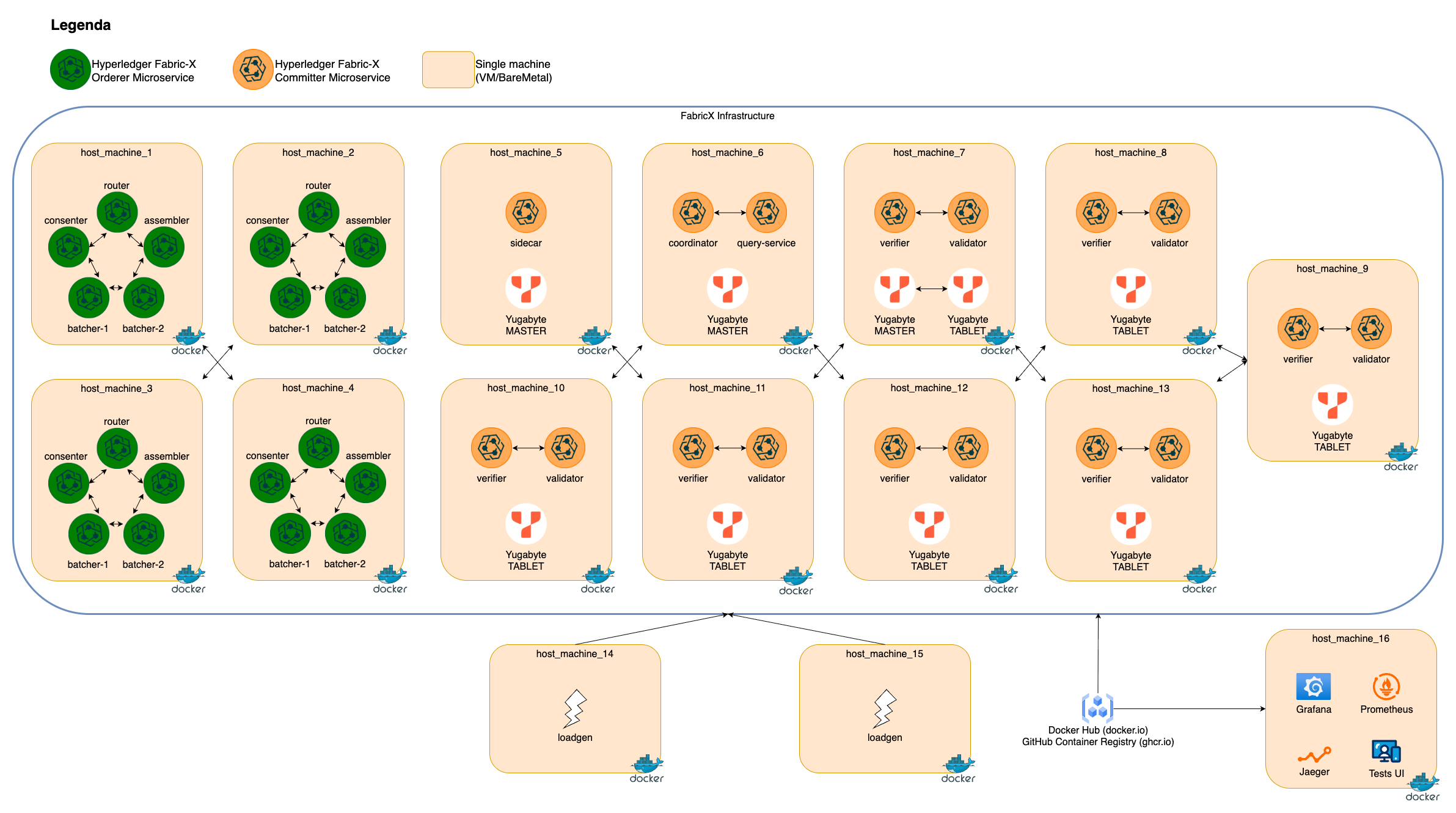
The diagram below summarizes this inventory's Fabric-X services and how they fit together.
Inventory Details
Ansible reaches the target machines over SSH. The Fabric-X services, YugabyteDB, load generators, and monitoring components run as containers on remote hosts.
The environment file distributed/group_vars/all/env.yaml defines the remote connection defaults, placeholder machines, and deployment directories.
This inventory describes a larger container-based Fabric-X deployment:
- No Fabric CA services. Crypto material is generated on the control node with
cryptogen. - 4 orderer groups. Each group has 1 router, 1 consenter, 1 assembler, and 2 batchers.
- 7 validators, 7 verifiers, 1 coordinator, 1 sidecar, and 1 query service.
- 3 YugabyteDB masters and 7 YugabyteDB tablets.
- 1 Block Explorer server and UI with its own PostgreSQL storage, co-located on the monitoring machine and streaming blocks from the committer sidecar.
- 2 load generators.
- Monitoring with 16 node exporters, 16 cAdvisors, Prometheus, Grafana, Loki, and Alloy.
flowchart TD
  all --> network
  network --> fabric_x
  all --> load_generators
  all --> monitoring
  monitoring --> prometheus
  monitoring --> grafana
  monitoring --> loki
  monitoring --> alloy
  monitoring --> node_exporter
  monitoring --> cadvisor
  grafana --> prometheus
  grafana --> loki
  alloy --> loki
  prometheus --> node_exporter
  prometheus --> cadvisor
  fabric_x --> fabric_x_orderers
  fabric_x --> fabric_x_committers
  fabric_x --> fabric_x_block_explorer
  fabric_x_committers --> fabric_x_committer
  fabric_x_orderers --> fabric_x_orderer_1
  fabric_x_orderers --> fabric_x_orderer_2
  fabric_x_orderers --> fabric_x_orderer_3
  fabric_x_orderers --> fabric_x_orderer_4
  fabric_x_committer --> committer_dbs
  committer_dbs --> yb_masters
  committer_dbs --> yb_tablets
This is a performance-oriented reference topology, not a small development sample. It scales validators, verifiers, batchers, load generators, and YugabyteDB tablets across 16 remote machine placeholders.
Fabric CA is intentionally omitted so large performance runs do not spend time starting CA services or enrolling identities. TLS and mTLS still use centrally generated cryptogen material.