local/fabric-x-bin.yaml
fabric-x-bin.yaml exercises binary deployment mode for Fabric-X and Fabric CA components on a single machine.
Use it when you want to test install, start, stop, and log handling for local binaries instead of containers.
Note
This inventory runs these components as binaries managed through tmux:
- Fabric CA servers
- Orderer components
- Committer components
- Load generator
cryptogenCLI- Fabric CA client CLI
PostgreSQL databases still run as containers.
Network Diagram
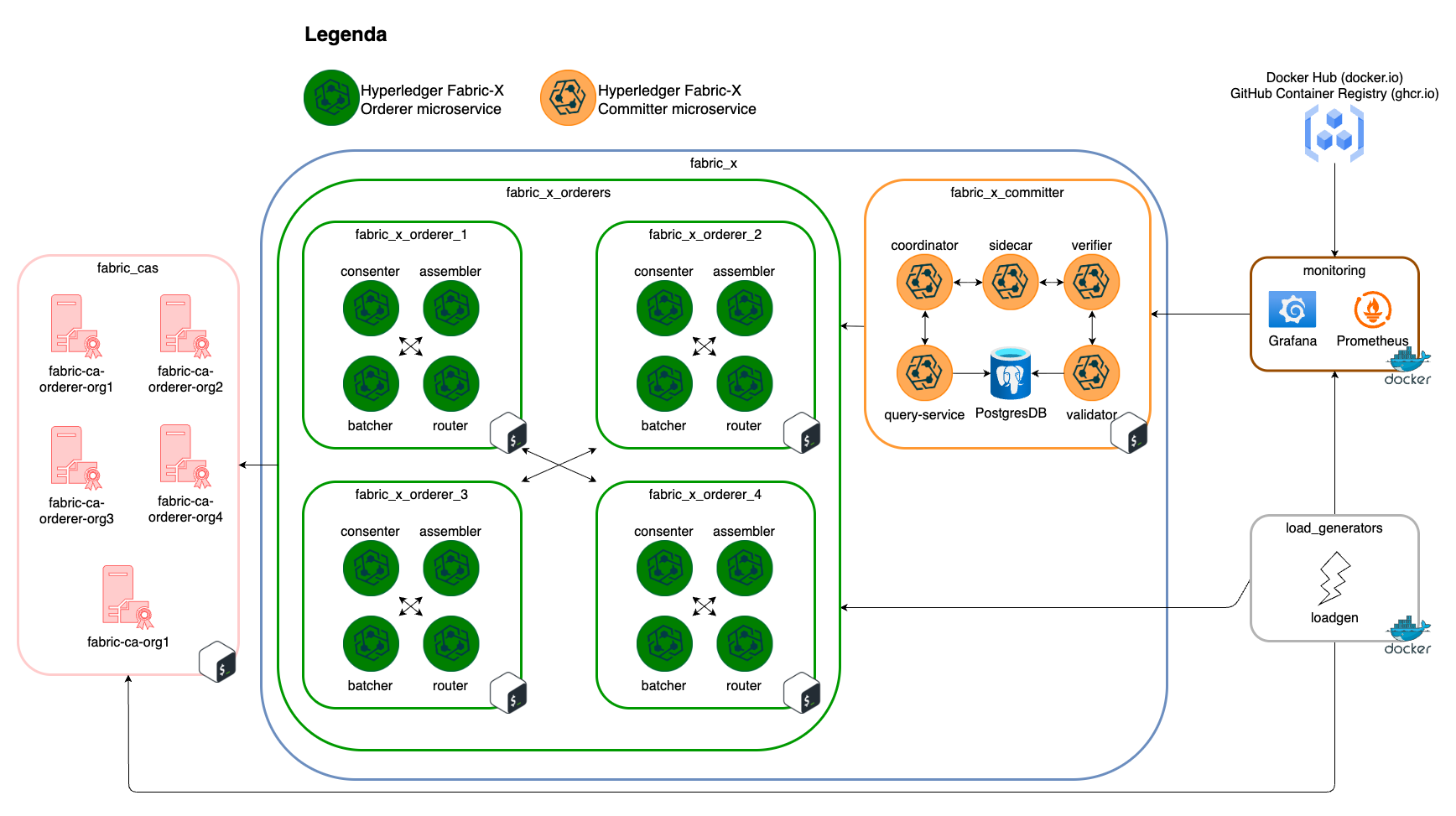
The diagram below summarizes this inventory's Fabric-X services and how they fit together.
Inventory Details
Fabric-X, Fabric CA, and the load generator use binary task paths and are managed through tmux. PostgreSQL databases still run through container task paths.
This inventory deploys these logical services on the local machine:
- 5 Fabric CA servers as binaries and 5 PostgreSQL databases for Fabric CA state as containers.
- 4 orderer groups. Each group has 1 router, 1 consenter, 1 assembler, and 1 batcher as binaries.
- 1 committer with validator, verifier, coordinator, sidecar, and query service as binaries.
- 1 PostgreSQL committer database as a container.
- 1 Block Explorer server and UI as containers, with PostgreSQL storage, streaming blocks from the committer sidecar.
- 1 load generator as a binary.
- Monitoring with node exporter, PostgreSQL exporter, cAdvisor, Prometheus, Grafana, Loki, and Alloy.
flowchart TD
  all --> network
  network --> fabric_cas
  network --> fabric_x
  all --> load_generators
  all --> monitoring
  monitoring --> prometheus
  monitoring --> grafana
  monitoring --> loki
  monitoring --> alloy
  monitoring --> node_exporter
  monitoring --> postgres_exporter
  monitoring --> cadvisor
  grafana --> prometheus
  grafana --> loki
  alloy --> loki
  prometheus --> node_exporter
  prometheus --> postgres_exporter
  prometheus --> cadvisor
  fabric_cas --> fabric_ca_servers
  fabric_cas --> fabric_ca_dbs
  fabric_x --> fabric_x_orderers
  fabric_x --> fabric_x_committers
  fabric_x --> fabric_x_block_explorer
  fabric_x_committers --> fabric_x_committer
  fabric_x_orderers --> fabric_x_orderer_1
  fabric_x_orderers --> fabric_x_orderer_2
  fabric_x_orderers --> fabric_x_orderer_3
  fabric_x_orderers --> fabric_x_orderer_4
The variables orderer_use_bin, committer_use_bin, fabric_ca_server_use_bin, and loadgen_use_bin select binary task paths. cryptogen_use_bin and fabric_ca_client_use_bin exercise the local helper binaries too.
The security posture matches the default local inventory: Fabric CA, TLS, and mTLS are enabled where supported.